




























Views
Downloads

Essential Human Body Systems Word Search | Grades 5-6

Paste this activity's link or code into your existing LMS (Google Classroom, Canvas, Teams, Schoology, Moodle, etc.).
Students can open and work on the activity right away, with no student login required.
You'll still be able to track student progress and results from your teacher account.
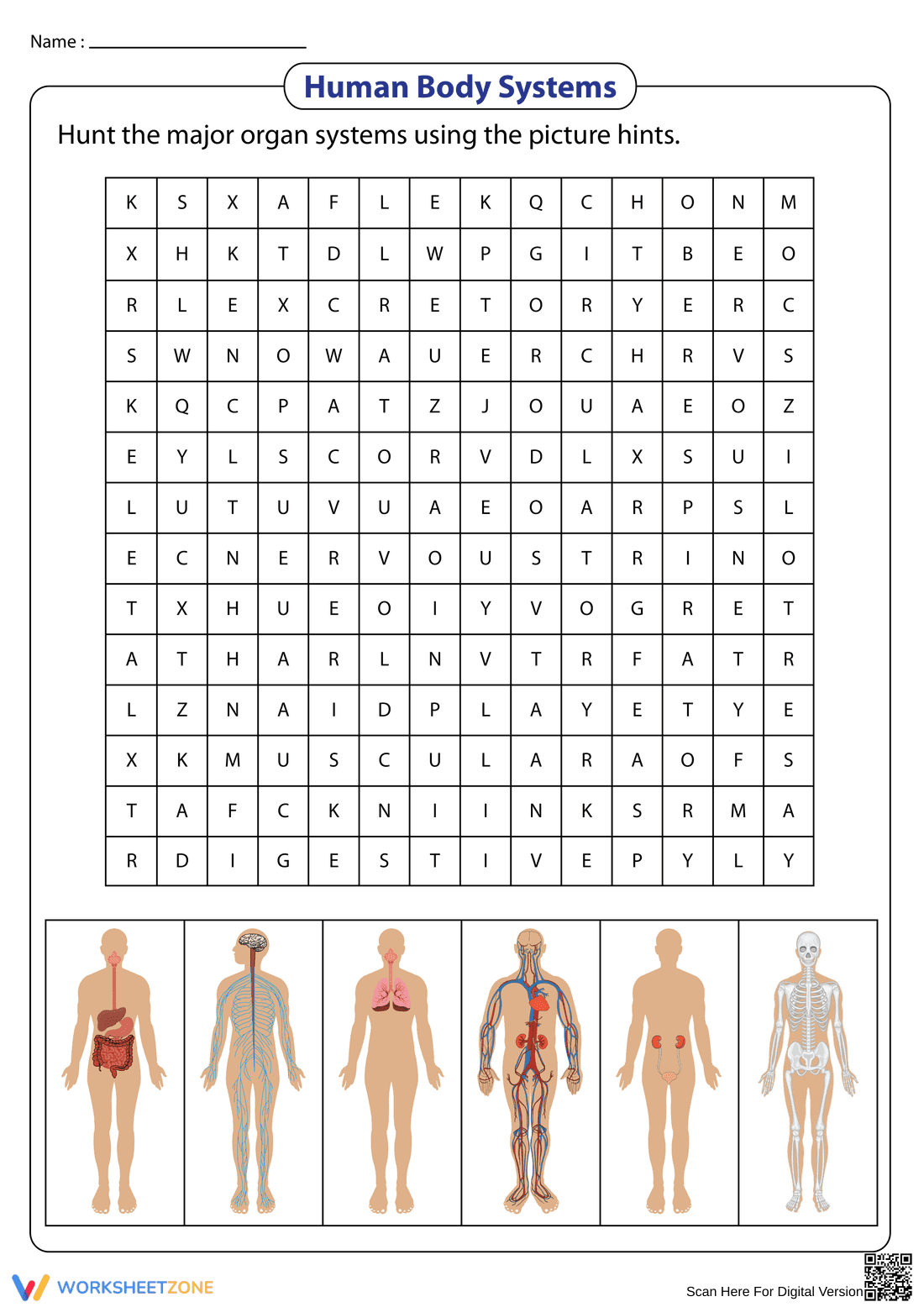
This interactive Human Body Systems word search helps Grade 5 and 6 students master essential anatomical vocabulary through visual recognition. By pairing detailed diagrams of major organ systems with a structured search grid, students reinforce their spelling and identification skills. It is an ideal supplemental resource for life science units focusing on internal structures and functions.
At a Glance
- Grade: 5–6 · Subject: Science
- Standard:
MS-LS1-3— Describe how the body is a system of interacting subsystems- Skill Focus: Human Body System Vocabulary
- Format: 1 page · 7 problems · Answer key included · PDF
- Best For: Fast finishers and science vocabulary review
- Time: 15–20 minutes
What's Inside
This single-page PDF features a word search grid containing seven primary organ systems. Below the grid, six high-quality anatomical illustrations serve as picture hints, requiring students to identify the system (Digestive, Nervous, Respiratory, Circulatory, Excretory, and Skeletal) before finding the corresponding word in the puzzle. A full answer key is included for quick grading or student self-correction.
Zero-Prep Workflow
Teachers can implement this activity in three simple steps: Print the single-page document (30 seconds), distribute to students during a transition or as a bell-ringer (30 seconds), and review the identified systems as a class (1 minute). Total teacher preparation time is under two minutes, making this an excellent choice for emergency sub plans or low-stakes formative checks.
Standards Alignment
Aligned to MS-LS1-3: "Use argument supported by evidence for how the body is a system of interacting subsystems composed of groups of cells." This activity supports the foundational step of identifying these subsystems before analyzing their complex biological interactions. Both standard codes can be copied directly into lesson plans, IEP goals, or district curriculum mapping tools.
How to Use It
Use this worksheet as a "hook" at the start of a human biology unit to gauge prior knowledge of organ systems. Alternatively, assign it as a post-instruction review to solidify spelling of technical terms. Observe students as they match the diagrams to the words; if they struggle with the nervous system illustration, it indicates a need for deeper direct instruction on neural pathways. Expected completion time is 15–20 minutes.
Who It's For
Designed for 5th and 6th-grade students in general education or ESL settings who need visual scaffolding for scientific terminology. It pairs naturally with an organ system anchor chart or a short reading passage on the functions of the circulatory and respiratory systems. This resource is particularly effective for learners who benefit from tactile-visual tasks to reinforce abstract concepts.
According to the NAEP Science Framework, mastery of scientific vocabulary is a significant predictor of reading comprehension in the content areas. This worksheet utilizes visual-verbal pairing—a technique supported by Fisher & Frey (2014) for the gradual release of responsibility—to bridge the gap between abstract biological concepts and concrete identification. By requiring students to interpret anatomical diagrams (MS-LS1-3) before engaging with the word search, the activity reinforces the spatial and structural components of human anatomy. Research in ScienceDirect TpT Analysis suggests that "ready-to-use" supplemental materials increase instructional efficiency by reducing administrative cognitive load on teachers. This 1-page resource ensures that students remain engaged with Grade 5-6 science standards while practicing essential spelling skills. This alignment to evidence-based practices ensures that the fun format of a word search translates into measurable gains in academic vocabulary retention for 5th and 6th grade learners.


